


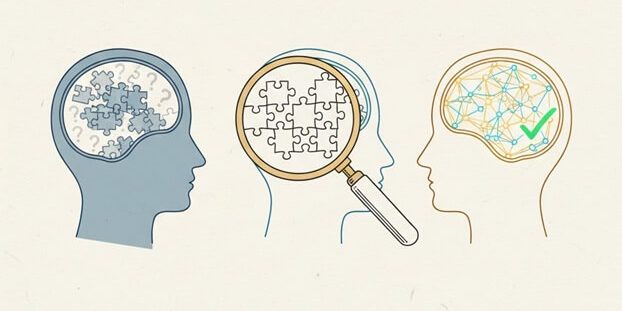
The most valuable currency in business isn’t just what your team knows today – it’s how fast they can acquire what they need for tomorrow. As AI takes over routine tasks, the competitive edge has shifted toward uniquely human qualifications: strategic leadership, emotional intelligence, and high-stakes global communication. What if you could transform your organization into a “learning machine” that identifies, acquires, and verifies these skills with mathematical precision?
The “expiration date” of professional skills
In 2026, professional qualifications that were cutting-edge two years ago are now the bare minimum. Companies are struggling with a “skills-drift” where their workforce’s capabilities no longer align with their technological tools or global ambitions.
It’s a frustrating cycle: You see a gap in leadership or a lack of proficiency in a new market language. You invest in a generic training program, but three months later, the results are invisible. Why? Because the training wasn’t targeted, the qualifications weren’t relevant to the 2026 landscape, and – most importantly – there was no objective way to measure the ROI of the learning process. You’re spending a budget on “development” without seeing “evolution.”
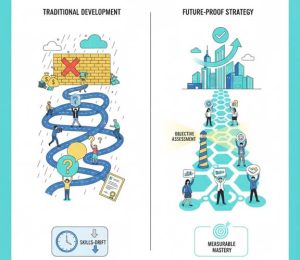
Why every training needs precise verification?
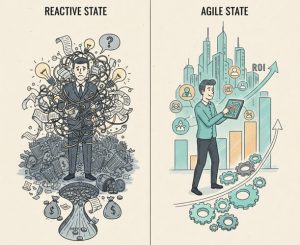
The traditional approach to professional development – buying a generic course and hoping it “sticks” – is a luxury no company can afford. We’ve all seen the “reactive state”: an organization playing an endless game of catch-up, reacting to skill gaps only after they start affecting the bottom line.
Now, imagine the “agile state”. This is an organization where talent development isn’t a line item in the budget, but a core business strategy. Here, training is intentional, outcomes are predictable, and growth is visible on a dashboard, not just a certificate.
To bridge the gap between where your team is and what market demands them to be, you need a two-pillar strategy: specialized training and precise verification.
- High-impact training: to stay ahead of AI, your teams must master the “human” skills that technology can’t touch – emotional intelligence, complex negotiation, and leadership in hybrid environments. They don’t need just theory; they need to build the practical competencies required for modern management, sales, and project delivery.
- The measurement of mastery: even the best training is only half the equation. To truly solve a talent shortage, you must move beyond “feel-good” feedback and into data-driven results. You need a baseline to know where you’re starting and a verification process to prove that the training actually delivered.
Development of language skills in 2026
Communication remains the most critical “power skill” of 2026. But “knowing a language” is no longer a specific enough goal. To build a global powerhouse, you need a nuanced development plan.
Imagine a development strategy that mixes the right methods for the right roles:
- Business writing courses: perfect for the era of asynchronous work and global documentation.
- Pros: high ROI for clarity and professionalism.
- Cons: doesn’t help in live negotiations.
- Conversation training: focused on “fluidity” and “confidence” for sales and leadership.
- Pros: rapidly builds trust with partners.
- Cons: can lack grammatical precision if not monitored.
- Classic language training: best for building a solid foundation in new markets.
- Pros: comprehensive and structured.
- Cons: can feel slow for busy professionals.
- Learning with AI: the 2026 standard for daily practice.
- Pros: instant, 24/7 availability for vocabulary and drills.
- Cons: lacks cultural nuance and the “human touch” needed for high-stakes business.
The most successful companies in 2026 use a blended Learning approach – using AI for drills, traditional learning for high-level communication and soft skills training, and language audits to ensure every cent of the budget is driving measurable progress.
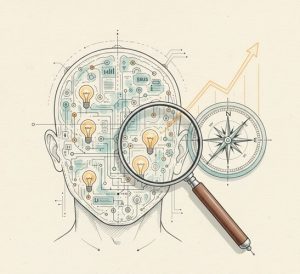
How to measure progress of language skills?
How do you know if your “business writing” course actually worked? Or if the “AI-tutoring” is translating into real-world fluency?
This is where Focus Audit Tool provides the data.
- The baseline: before starting any training program, we audit the team to identify exactly where the gaps are.
- The progress map: we provide standardized CEFR-level verification at regular intervals. You don’t just “feel” like the team is better; you have the data to prove their writing has moved from B2 to C1.
- ROI validation: by mapping the skills before and after training, HR leaders can finally show a clear line between training spend and qualification growth.
How to hire the best talents?
The talent war of 2026 won’t be won by the biggest hiring budget, but by the smartest development strategy. Stop guessing which qualifications your team needs and stop hoping that your training is working.
By combining the pedagogical expertise of Mistrzowie Szkoleń with the rigorous verification of Focus Audit Tool, you create a loop of continuous, measurable improvement.