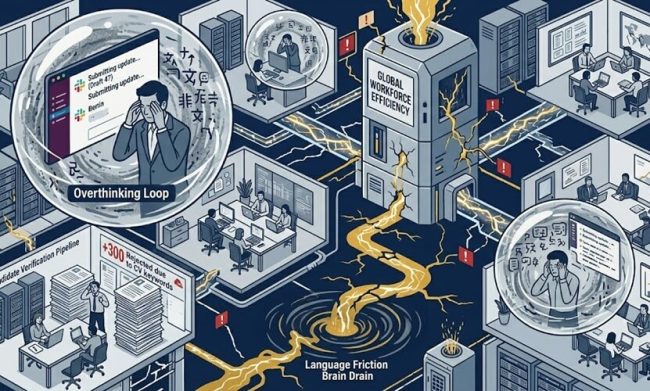
Reading an email and commanding a live client call engage two entirely different cognitive pathways. When candidates rely on digital helps, context clues, and asynchronous buffer time, their passive reading skills can easily mask weak active speaking ability – until stress and time constraints cause performance to break down. Here is how you can identify…
One of the most common – and costly – mistakes in international recruitment is over-requiring or under-specifying language levels for open positions. When job descriptions default to generic requirements like “Must speak fluent English,” or demand a certified “C1” for every role regardless of function, recruitment pipelines stall. You end up rejecting capable technical talent…
Allocating annual upskilling budgets is a high-stakes balancing act. Training programs are meant to close critical capability gaps, drive performance, and boost employee retention. However, without accurate, data-driven skill mapping, you might fall into two expensive traps: over-training employees on skills they already possess, or under-training employees who lack basic foundational capabilities. Both scenarios represent…
In global talent acquisition, the language section of a candidate’s CV is statistically one of the most unreliable data points in the entire hiring funnel. Faced with intense competition for remote and international roles, applicants frequently view language skills as a grey area ripe for “optimistic estimation.” Vague self-assessments like “fluent,” “professional working proficiency,” or…
In international recruitment and internal talent mobility, few terms are as misleading as “conversational fluency.” When reviewing resumes or conducting informal chats, HR managers frequently encounter candidates who speak casually, confidently, and with great ease. However, when those same employees are placed into high-stakes environments – such as delivering a C-suite presentation, negotiating a contract,…
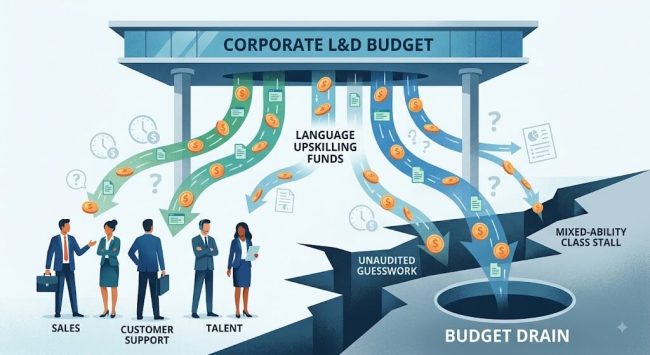
Every year, Learning & Development (L&D) directors allocate substantial budgets to language upskilling. The goal is strategic: prepare sales teams for global markets, enable customer support to handle international clients, and build a cross-border talent pipeline. Yet, despite millions spent on foreign language courses, HR and L&D leaders frequently face a frustrating reality: low completion…
As remote hiring becomes the standard for international teams, Talent Acquisition leaders face an unprecedented operational challenge. The rapid adoption of generative AI tools like ChatGPT, Claude, and real-time translation plugins has fundamentally disrupted online candidate assessments. What used to be a reliable remote language screening process is now vulnerable to sophisticated digital cheating. For…
Every year, Human Resources and L&D directors face the same high-stakes challenge: defending their budgets in front of the board. When it comes to traditional corporate benefits, language courses are often among the first to be questioned by Chief Financial Officers looking to trim operational costs. The board doesn’t think in terms of “employee satisfaction”…
IT recruitment beyond code: why assessing soft language skills matters just as much as technical proficiency For years, the tech industry operated under a simple hiring philosophy: if the code is clean, the candidate is a match. Tech recruiters spent the majority of their energy coordinating live coding sessions and reviewing GitHub repositories. If a…
Every recruiter has seen it. You open a CV, scroll down to the skills section, and there it is: German – B2 (Upper-Intermediate). It has become the default setting for the modern resume. In fact, internal data shows that up to 80% of corporate job applicants claim some variation of intermediate language proficiency. But when…
We use cookies on our website to give you the most relevant experience by remembering your preferences.
By clicking "Accept All", you consent to the use of ALL cookies. You can change this in "Cookie Settings".
This website uses cookies to improve your experience while you navigate through the website. Out of these cookies, the cookies that are categorized as necessary are stored on your browser as they are essential for the working of basic functionalities of the website. We also use third-party cookies that help us analyze and understand how you use this website. These cookies will be stored in your browser only with your consent. You also have the option to opt-out of these cookies. But opting out of some of these cookies may have an effect on your browsing experience.
Necessary cookies are absolutely essential for the website to function properly. This category only includes cookies that ensures basic functionalities and security features of the website. These cookies do not store any personal information.
Functional cookies help to perform certain functionalities like sharing the content of the website on social media platforms, collect feedbacks, and other third-party features.
Performance cookies are used to understand and analyze the key performance indexes of the website which helps in delivering a better user experience for the visitors.
Analytical cookies are used to understand how visitors interact with the website. These cookies help provide information on metrics the number of visitors, bounce rate, traffic source, etc.