


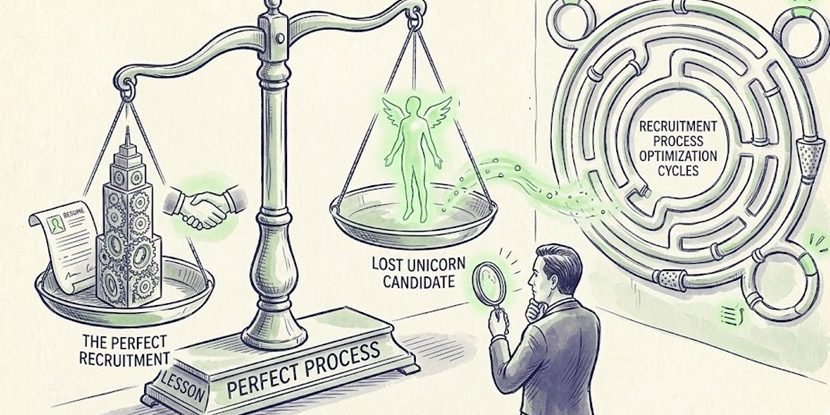
It is a frustrating reality for every recruiter: a candidate who seemed like a perfect fit suddenly stops responding or declines an offer at the last minute. They stop replying to emails. They miss the second interview. They ghost you. If you aren’t asking why this happens, you’re recruiting in the dark. In recruitment, the “no” is rarely the end of the story – it’s just a data point in a much larger cycle of recruitment process optimization.
Stop guessing: the power of the exit interview
When a top candidate declines an offer or disappears, do you actually follow up? If not, you’re missing the most valuable data in your department.
Don’t just let them walk away. Call them or send a personalized email. Offer them a choice to make it easy:
- “Would you be open to a 5-minute chat?”
- “Could you click one of these three reasons why you chose another path?”
- “Would you mind filling out a 2-question anonymous survey?”
Without this feedback loop, you are just guessing why your recruitment funnel is leaking.

The compensation reality check
As a recruiter, you may not always decide the final salary, but you are the one who sees the market data. Think of a candidate’s expertise as a service you are buying. Just like software, different “packages” come with different price tags. If your offers are being rejected because of money, use that data to show your supervisors what the market actually demands.
Pro-tip on benefits: if you can’t increase the base salary, look at your benefits. Instead of a standard list, consider a flexible “points” system. This allows employees to earn points and decide for themselves how to spend them – whether on health, education, or lifestyle perks.
Stop writing generic job advertisements
Most job ads look exactly the same, which is a mistake. Top talent wants to know exactly what their Tuesday morning will look like.
Stop saying: “International environment.”
Start saying: “You will lead daily stand-ups with our tech teams in Berlin and Warsaw via Zoom.”
Stop saying: “Attractive bonus scheme.”
Start saying: “Base salary + a quarterly performance bonus tied to hitting 95% of your KPI targets, such as [example task].”
Stop saying: “Flexible working hours.”
Start saying: “Core hours are 10:00 AM – 3:00 PM. You choose when to put in the rest of your time.”
The perspective shift: take a moment to look at your ad. Is the section about your company history three times longer than the section describing what the employee will actually do? Candidates care more about their future day-to-day tasks than your company’s founding story.
Explaining and simplifying the recruitment process
Candidates are often juggling multiple applications. If they don’t know what to expect from you, they will move toward a company that is more transparent.
- Define the roadmap: clearly state how many tests and calls are required for the specific position.
- Consistency: ensure the general information in your ad matches the specific details given during the first call.
If your process is too long or complicated, audit it immediately. Identify which steps can be sped up or combined. In a competitive market, speed is often the deciding factor.
Moving beyond generic feedback
Asking a candidate to complete five tests and three interviews only to send them a “standard rejection” email is a major mistake.
You ask a candidate to take five tests, perform a practical task, and attend three calls. If they fail, and you send a template that says, “Thank you for your interest, we have decided to move forward with other candidates,” you have just damaged your brand.
Automation is great for efficiency, but you should use tools that allow for personalization at every step.
If you ask a candidate to do a task before a call, give them a brief update on how it went or mention a specific part you’d like to discuss. That “human touch” is what wins over high-level talent who have multiple offers on the table.
Automation is necessary for scale, but it shouldn’t be cold.
- Add personalization: if they took a language test, tell them their score.
- Reciprocity: if they gave you four hours of their life, give them five minutes of yours. Even a small note like, “Our team really liked your approach to the technical task, but we needed someone with more experience in X,” can turn a rejected candidate into a brand advocate.

The need for a dedicated careers page
If you only post on LinkedIn or job portals, you are missing a layer of trust. In an era of “ghost jobs” and recruitment scams many candidates view third-party portals with suspicion, fearing scams or “CV collection” schemes. They will go to your website to verify you and your job ad are real.
Candidates will almost always check your official website before applying. A dedicated Careers Page makes the application feel safer and more professional. It’s your digital storefront – if it’s missing, you lose credibility.
It is your chance to also show the “vibe” of the office, the faces of the team, and the stability of the company. Candidates check LinkedIn for the job, but they check your website to see if they can trust you.
The “talent pool” lie: why your silver medallists never come back
We all know it: “You were a great candidate, but we chose someone who was a slightly better fit for our current needs. Can we keep your CV for future opportunities?”
The candidate says yes. They feel respected. They wait.
Then, two months later, they see your company post a new job ad for the exact same role – or a similar one they are perfectly qualified for. But they never get an email. They never get a call. To the candidate, it feels like they were lied to. It feels like their “gold standard” test results and hours of interviewing were thrown in the trash.
Then comes the worst part: the two-year ghost. Out of nowhere, eighteen months later, a recruiter reaches out as if no time has passed: “Hi! We saw your CV in our database and want to schedule a call.” By this time, the candidate has likely moved on, found a company that values them, and left a negative review of your process online.
Why the “ghost” talent pool is a business failure:
- Wasted sourcing budget: you are paying to find new leads while ignoring verified, high-quality candidates already in your database.
- Data decay: if you don’t reach out for a year, the candidate’s skills, salary expectations, and seniority have all changed. Your “data” is now useless.
- Brand hypocrisy: if you promise to “stay in touch,” you must have a process to actually do it. Otherwise, you are damaging your employer brand.
How to fix your talent management:
- Use your data first: before you spend a cent on a new LinkedIn ad, search your database for candidates who can already by a match.
- The “current status” email: if you aren’t hiring for their role right now, send a simple, automated update every 3 or 6 months: “We haven’t forgotten you. We aren’t hiring for [Position] currently, but we still value your profile. Here is what’s new at our company.” – use this moment to also ask how candidate is doing, and if they would like to update some information.
- Human context: if you reach out after a long silence, acknowledge it. Don’t act like it’s day one. Say: “We’ve been following your progress, and we finally have a role that matches the high level of skill you showed us last year.”
Winning the best talent requires constant work – and that includes the talent you already found. Don’t let your talent pool become a talent graveyard.

Learning to accept the “no”
Sometimes, you do everything right, and you still lose. That’s life. You can’t win them all, but you can learn from every loss.
Keep the door open: treat the “no” with respect. A candidate who says no today might be a great fit a year from now.
Refine your process: use every piece of candidate feedback to tweak your ads, your interviews, and your timing.
Winning the best talent isn’t a one-time event – it’s a process of constant improvement. Keep your “silver medalists” (the #2 candidates) in your talent pool, keep refining your job ads, and always – always – ask for feedback.
The best recruiters don’t just find people; they build a process that people don’t want to leave.
Sometimes, despite a perfect process, the candidate still chooses another path. It’s frustrating, but it’s part of the game. However, how you handle that “no” determines your future employer brand reputation.
The “boomerang” strategy
I once saw a company lose a top CTO candidate to a massive competitor. Instead of ghosting back, the HR Director sent a genuine note: “We’re disappointed but thrilled for your new chapter. Let’s grab a coffee in six months just to see how you’re doing.” Eighteen months later, that CTO realized that this company simply wasn’t a match for him. Because of that one email, the first person he called was that HR Director.
Conducting a “recruitment retrospective”
When you lose a “unicorn”, don’t just move to the next file. Hold a 5-minute retrospective with your team:
- Did we move too slow at the offer stage?
- Did the candidate’s expectations of the role match the Team Lead’s?
- Was our “package” realistically aligned with current market trends?
Winning talent requires constant work. You are never “finished” with your recruitment strategy. It is a living process that needs to be tuned every month based on the feedback you receive. By treating every rejection as a lesson, you stop losing talent and start building a talent pipeline that actually lasts.

The “ghost-busting” candidate experience survey
To stop the “ghosting” trend, you need data. Send this to candidates who have declined an offer or dropped out of the process. Keep it short – it should take less than 60 seconds to complete.
Subject: We’d love your honest feedback (it helps us grow!)
Text: Hi [Candidate Name],
While we’re sorry we won’t be working together this time, we want to make sure our recruitment process is as good as it can be for future talent.
Would you mind sharing why you chose a different path? (Please be honest – we can take it!)
- What was the primary reason for your decision?
- [ ] Compensation/Benefits package
- [ ] Better growth opportunities elsewhere
- [ ] The recruitment process was too long/complicated
- [ ] The job role was different than I expected
- [ ] Cultural fit/Company reviews
- [ ] Other….
- How would you rate your experience with us (1–5 stars)?
⭐ ⭐ ⭐ ⭐ ⭐
- One thing we could do better?
[Short text box]
- Would you like to stay in our talent pool for future roles?
- [ ] Yes, keep me posted!
- [ ] No, thanks.