


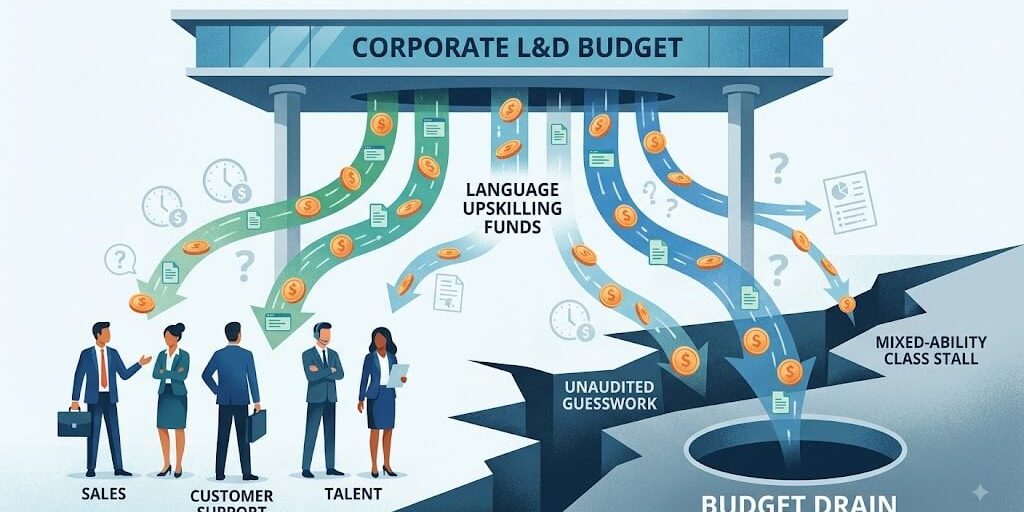
Every year, Learning & Development (L&D) directors allocate substantial budgets to language upskilling. The goal is strategic: prepare sales teams for global markets, enable customer support to handle international clients, and build a cross-border talent pipeline.
Yet, despite millions spent on foreign language courses, HR and L&D leaders frequently face a frustrating reality: low completion rates, minimal real-world performance gains, and an inability to show clear return on investment (ROI) to the C-suite.
The primary culprit isn’t a lack of candidate motivation or poor course content.
Funding language training without independent, standardized baseline audits before and after the program turns a strategic investment into a high-stakes guessing game.

The pre-course audit – mapping the true starting line
Enrolling employees in a language course based on self-reported skills or informal manager feedback is a recipe for wasted budget. Self-assessments are notoriously inaccurate: overconfident employees land in classes above their head, while underconfident team members repeat concepts they mastered years ago.
A rigorous, independent baseline audit before training begins eliminates guesswork and builds a targeted roadmap:
Pinpointing core skill gaps
Language proficiency isn’t a single score – it’s a composite of reading, writing, listening, and real-time speaking. A support engineer might read documentation at a C1 level but freeze during a B1-level spoken call. Pre-course auditing uncovers these precise asymmetries, ensuring budget is spent strengthening actual weaknesses rather than re-teaching existing strengths.
Strategic cohort grouping (no more mixed-ability classes)
Placing a true A2 student in a business English class with a fast B2 student stalls progress for both. The lower-level employee feels overwhelmed; the advanced employee gets bored and disengages. Baseline audits allow L&D teams to group learners by precise Common European Framework of Reference for Languages (CEFR) levels and specific professional needs, maximizing classroom efficiency.
Hyper-personalized success roadmaps
Generic “one-size-fits-all” language tracks rarely yield business results. With clear diagnostic data from a pre-course audit, L&D can build personalized learning maps. An account manager aiming for global client presentations receives a targeted path to master persuasive speaking, while a developer focuses purely on technical correspondence.

The post-course audit – proving ROI and continuous optimization
Setting up a course is only half the equation. Without a standardized post-course evaluation, L&D leaders cannot answer the most critical question asked by executive leadership: “Did this program actually work?”
Post-course audits serve as the quantitative proof of your training strategy:
Measuring real progression against CEFR standards
Relying solely on course attendance or vendor-issued certificates of completion creates a false sense of security. Attendance does not equal fluency. Independent post-training audits verify whether an employee actually moved from B1 to B2 on an objective, audited scale.
Iterating and updating training plans
Language learning isn’t a one-time event – it’s an evolving capability. Post-course audit results highlight who is ready to move on to advanced business communication, who needs maintenance, and where curriculum adjustments are needed for the next training cycle.
Justifying L&D spend to the board
When HR can present hard, audit-backed data – such as “85% of customer support representatives achieved certified B2 spoken fluency within 6 months, reducing time-to-resolution by 18%” – language training stops being seen as a luxury perk and becomes a recognized strategic driver.
Moving from “attendance-based” perks to data-driven impact
Corporate language training should never be treated as an unmeasured employee benefit. In a modern, data-driven enterprise, every money spent on L&D must tie back to measurable workforce capability.
By implementing independent, automated language audits before and after your training programs, you protect your budget, optimize learning speed, and guarantee that your workforce develops the real-world communication skills your business demands.