


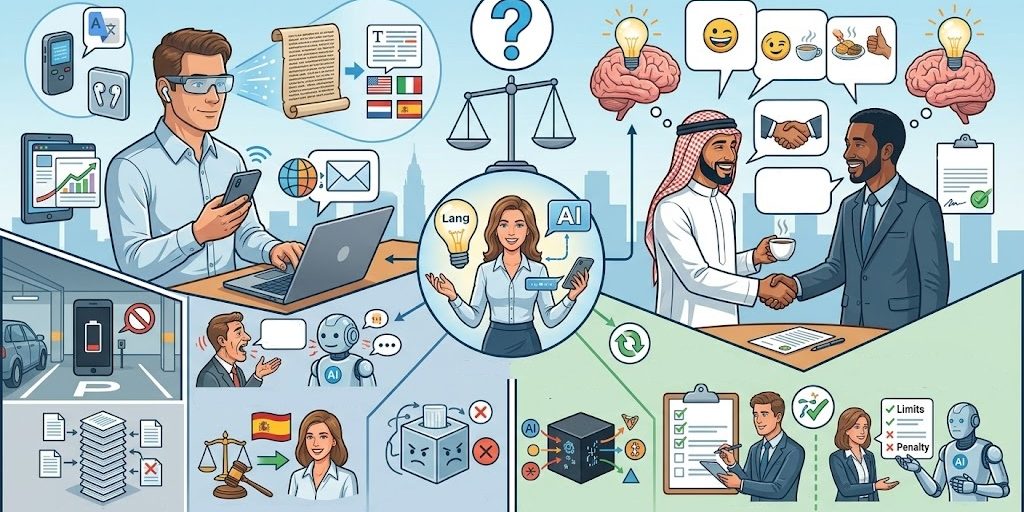
AI writes emails, translates entire documents in milliseconds, and turns science-fiction gadgets into our everyday reality. Simply put on simultaneous translation earbuds or slip on augmented reality glasses, and you can hear a foreign language seamlessly converted into your native tongue. Faced with such capabilities, a natural question arises: does learning foreign languages still make sense, or has it become a sentimental relic of the past?
AI – revolutionary support tool
Artificial intelligence can instantly draft a professional business message in a language you don’t know or accelerate your daily learning process. Modern educational platforms like LANGZY are great examples, using smart algorithms to personalize lessons, tailoring the pace and difficulty directly to the user’s needs.
AI makes a brilliant assistant, tutor, and productivity booster. However, it is not a magical panacea destined to completely replace the human brain and multi-dimensional understanding of the world. Treating it as an infallible solution to every communication challenge is a trap.
The market is flooded with devices promising total liberation from language barriers. Smart glasses displaying real-time translations, compact mobile translators, and advanced earbuds work wonders in tourist scenarios or simple business meetings. They act as a wonderful safety net.
The trouble starts when technology falters – when the battery dies, internet connection drops in a parking garage, or emotional nuances in a conversation demand something far beyond literal, word-for-word translation.
Can we fully trust AI?
Depending entirely on AI without knowing the language at any foundational level carries significant risks:
- The verification gap: if you don’t know the language, you cannot judge whether the AI-generated translation is accurate, awkward, or – worse – contains a critical error that alters a contract’s meaning.
- Culture and context: language isn’t just grammar; it embodies cultural codes. AI often struggles with irony, local idioms, or subtle humour, which can lead to severe misunderstandings in business or diplomacy.
- Pronunciation and accent hurdles: advanced algorithms handle clean speech brilliantly, but what happens when your interlocutor mumbles, speaks with a heavy regional accent, or talks in a rushed manner? AI can drastically misinterpret the intent.
- The vocabulary trap: when AI feeds you an advanced corporate phrasing that you don’t fully understand yourself, you risk using it out of context. Worse yet, if the other party asks for clarification, you will be left helpless, unable to explain your own thought.
The “AI slop” era and the human-first customer service shift
Society is growing increasingly fatigued by what is known as AI slop – the flood of derivative, automatically generated content clogging the internet, inboxes, and social media feeds. Brands and individuals who completely abandon their human voice in favour of blindly copy-pasting AI texts lose authenticity. Customers can smell “plastic” corporate communication from a mile away.
The same goes for ubiquitous automated phone bots and chatbots in customer service that frustrate rather than help. Legislative reactions reflect this growing discontent – for instance, laws introduced in Spain legally guarantee citizens the right to speak to a real human being when dealing with public services and banking. The market is starting to re-evaluate and reward the human element.
The algorithm’s “black box” and unseen biases
As regular tech users, we have zero control over or visibility into the training data behind the AI models we use. These models can subconsciously favour certain speaking styles, impose a specific (e.g., Western) worldview, or replicate hidden biases and marginalize minority languages and cultures. Without knowing the language yourself, you will never spot those subtle, discriminatory nuances that the algorithm deemed “standard.”
Why AI cannot replace humans in language auditing
The rise of AI has led many companies to attempt language proficiency testing using automated tools alone – or to partner with vendors who have completely eliminated human educators from the evaluation process. While relying solely on algorithms to assess complex skills like writing and speaking sounds fast and cost-effective, it introduces a severe evaluation risk.
AI can easily tally vocabulary counts and spot basic grammatical errors, but it completely lacks human linguistic intuition. An algorithm cannot reliably detect subtle tone, gauge natural conversational flow under pressure, or distinguish genuine fluency from a mechanically memorized script. Fully automated assessment tools also tend to penalize creative yet entirely correct expressions simply because they fall outside standard algorithmic training sets.
Accurately evaluating how someone speaks and writes in a real-world professional context requires a qualified human auditor. While AI can serve as a helpful assistant in organizing test data, stripping human expertise entirely out of language verification leaves companies blind to whether a candidate can actually connect and communicate with real people.
Be better than AI
Knowing a foreign language has evolved from a tedious chore of rote memorization into a competence of critical thinking and personal freedom. AI and modern gadgets are phenomenal tools that enhance our daily lives – they ease the onboarding process, accelerate learning, and assist us in high-pressure moments.
However, true flexibility, deep business relationship-building, and confidence begin precisely where AI code ends. Language is not merely a tool for data exchange – it is a way of thinking that an algorithm cannot fully experience on our behalf.