


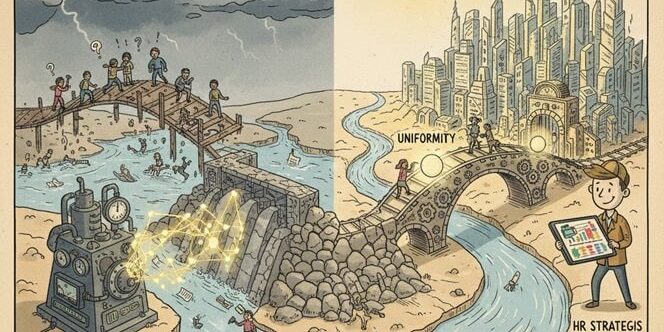
What if you had a 360-degree “heat map” of your company’s true capabilities? What if you could stop wondering if you have the talent to expand into a new market and instead know exactly who is ready to lead the charge? Mapping competencies isn’t just an HR exercise – it’s the master key to identifying critical shortages, uncovering hidden gems within your team, and future-proofing your business against a tightening global talent market.
The cost of flying blind
Imagine a major tech firm preparing for a high-stakes expansion into the German market. On paper, their workforce looks perfect. Their internal database shows dozens of employees with “German: fluent” listed on their CVs from five years ago.
Based on this data, company bypasses external hiring and forms a localized task force. But three months in, the cracks appear. The “fluent” team members can handle complex negotiations and technical documentation but a casual lunch with Clients and team meetings are a huge problem. Communication breaks down, deadlines are missed, and a multimillion-dollar partnership begins to sour.
This is the invisible gap. It occurs when organizations rely on outdated self-assessments or “gut feelings” rather than objective data.
Now, imagine the alternative. Before the expansion, company conducts a competency mapping audit. They don’t just look at job titles – they look at verifiable skills. They use objective testing to find that while five people claimed fluency, only two have the C1 German level required for the task.
However, the audit also reveals a “hidden gem”: a junior analyst in the Finance department, originally from Lisbon, with certified native-level proficiency and a background in contract law. By mapping first, they doesn’t just fill a gap – they find a strategic leader they didn’t even know they had.

What is competency mapping and why does it matter in 2026?
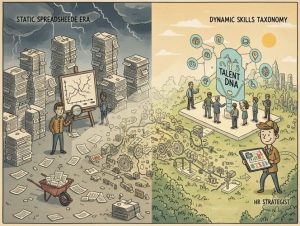
At its core, competency mapping is the strategic process of identifying and evaluating the specific skills, knowledge, and behaviours required to succeed in any given role. In the high-speed landscape of 2026, it has evolved from a static HR spreadsheet into a dynamic skills taxonomy – a “living” database that tracks the DNA of your organization’s talent. By moving beyond vague job titles and looking at a granular skills matrix, companies can move from reactive hiring to predictive talent management.
The true power of competency mapping lies in its ability to drive workforce optimization. When you map competencies with objective data, you aren’t just filing reports; you are building an internal talent marketplace. You gain the agility to redeploy staff where they are needed most, reduce the risk of costly hiring mistakes (which statistics show account for 80% of employee turnover), and ensure that your Learning and Development (L&D) budget is spent on closing actual, verified gaps rather than generic training.
Strategic solutions for a skills-first world
In 2026, the shift toward skills-based talent management is no longer a trend – it’s a necessity. Identifying critical shortages is the first step in moving from a reactive “hiring mode” to a proactive “strategy mode.”
Here is how successful organizations are solving the talent shortage today:
- Dynamic competency mapping: moving beyond static spreadsheets. Modern HR teams use dynamic frameworks to categorize core, technical, and soft skills (like communication and adaptability) across the entire organization.
- Predictive gap analysis: instead of waiting for a vacancy, leaders use data-driven insights to forecast where skills will be needed in 12–24 months, aligning their talent pipeline with long-term business goals.
- Internal mobility & reskilling: once a shortage is identified, the most cost-effective solution is often right in front of you. Mapping allows you to move people horizontally into high-impact roles where their existing skills can be “topped up” with targeted training.
Why strategy fails without objective verification
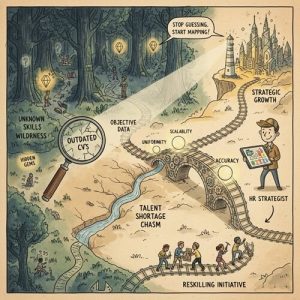
Most skills-based talent management initiatives hit a wall for one simple reason: the data is subjective. When you build a competency map based on self-reported skills or outdated manager observations, you are building on sand. Studies consistently show that employees often over-estimate or under-estimate their own proficiency, especially in nuanced areas like business communication and language skills.
If your “strategic map” says an employee is a “Level 4” but they can’t successfully lead a cross-border project meeting, the map isn’t just useless – it’s a liability. To move from a theoretical plan to a high-performance reality, you need to solve the “Verification Gap.” You need a way to transform qualitative human traits into quantitative talent metrics.
The bridge to workforce agility is objective assessment. By integrating a standardized skills assessment platform into your mapping process, you achieve three things:
- Uniformity: you ensure that “advanced” means the same thing in your Tokyo office as it does in your Berlin office.
- Scalability: you can audit as many employees’ as you want within a week, rather than taking months of personal interviews.
- Accuracy: you remove the “halo effect” and unconscious bias from the equation, ensuring that promotion and development decisions are based purely on verifiable merit.
Strategic HR leaders in 2026 know that a map is only as good as the accuracy of its coordinates. Before you can plan where your talent is going, you must have an undeniable, data-backed record of exactly where they are.
Turning data into certainty
At Focus Audit Tool, we believe you cannot manage what you cannot measure. While many competency maps focus on broad categories, we specialize in the most critical (and often most “guessed”) skill: language proficiency.
- Standardized verification: we replace “Fluent” or “Conversational” with objective CEFR reports (A1-C1). This provides the hard data you need for your competency map.
- Candidate & employee audits: whether you are vetting a new hire or auditing your current global workforce, our platform provides results in as little as 24 hours, ensuring your strategy is built on facts, not assumptions.
- Identifying “hidden” assets: our audits often reveal bilingual or multilingual talents in departments where their skills were previously underutilized – giving you an instant “internal hire” for international projects.
Stop guessing. Start mapping.
A talent shortage is only a crisis if you don’t see it coming. By mapping your competencies today, you turn “empty chairs” into a strategic roadmap for growth.
Whether you are preparing for a merger, a new market entry, or simply want to maximize the potential of your current team, the first step is verification.