



A candidate has the perfect background, the right software experience, and that one golden phrase: “French: fluent.” But “fluency” is a subjective, elastic term. To a candidate, it might mean they can order a coffee in Paris. To a CEO, it means they can lead a 40-minute negotiation on contract liability without missing a beat.
When these two definitions clash, the result is more than just an awkward interview – it’s a systemic recruitment risk management failure.
The psychology of candidate dishonesty: why “fluency” is a trap
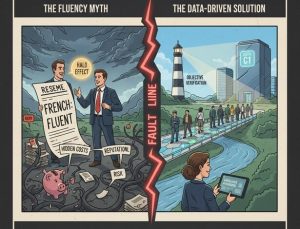
Why is candidate dishonesty so rampant regarding language? It’s rarely about malice; it’s about survival and the “halo effect.” Candidates know that “intermediate” doesn’t get them the interview, so they round up. There are so many companies that don’t verify this, seeing it only as unnecessary cost, so they can simply give it a try. What’s the harm in trying for them, the candidates? Well, it certainly does a lot for you, hiring such a person.
In recruitment, the Halo Effect occurs when a candidate is charismatic or well-dressed, leading the recruiter to subconsciously assume they are also competent in technical skills like language. If they speak with a confidence, we check the box for “fluent.” This is how the CV fluency lies begin.
Without a specialized language assessment tool, recruiters are essentially gambling on a candidate’s self-perception rather than their actual performance.
The hidden costs of hiring for languages without data
When you fail to verify language skills accurately, the costs ripple through the entire organization. It isn’t just about a “bad hire”; it’s about the operational friction that follows.
- The onboarding drain
It costs roughly 30% to 50% of an annual salary to replace an entry-level employee, and up to 150% for a mid-to-senior level manager. If a hire fails in month three because they cannot communicate with international stakeholders, your ROI on that recruitment cycle is negative.
- The “shadow work” problem
When a “false positive” enters a team, they don’t work in a vacuum. Other team members – often the high performers – end up doing “shadow work.” They proofread the new hire’s emails, take over their international calls, and fix their communication errors. This leads to burnout and resentment among your best staff.
- Reputational risk
In many industries precision is everything. A single linguistic nuance missed in a contract or a support ticket can lead to a churned client or a legal dispute.

HR screening tips: moving beyond the “quick chat”
Traditional HR screening tips often suggest having a five-minute conversation in the target language. While well-intentioned, this is deeply flawed for two reasons:
- Social vs. professional language: many people have high “BICS” (Basic Interpersonal Communication Skills) but low “CALP” (Cognitive Academic Language Proficiency). They can talk about the weather, but they cannot explain a complex software integration.
- Recruiter bias: if the recruiter is not a C2-level speaker themselves (not even all native speakers are!), they cannot accurately assess the nuances between a B2 and a C1 candidate.
To truly mitigate risk, companies must shift to language proficiency verification that is standardized, objective, and scalable.
How to understand CEFR levels?
The only way to kill the myth of “fluency” is to replace it with the CEFR levels (Common European Framework of Reference for Languages). This framework removes the guesswork.
- CEFR A1 and CEFR A2: Can handle simple tasks; not suitable for professional communication.
- CEFR B1: Can manage routine office tasks but struggles with complex nuances.
- CEFR B2: The professional baseline. Can interact with a degree of fluency that makes regular interaction with native speakers possible.
- CEFR C1 and CEFR C2: Can use language flexibly for social, academic, and professional purposes. Can grasp implicit meaning. Can express themselves spontaneously and precisely, differentiating finer shades of meaning in complex situations.
Using a Focus Audit Tool to map candidates to these levels ensures that every hire meets the specific linguistic demands of their role.

Automated CEFR verification: Focus Audit Tool
In the past, high-quality language testing was slow, expensive, and manual. You had to book a session with a language school and wait days for a report. For a modern HR department, that delay is unacceptable.
Why automation is non-negotiable for modern HR:
- Consistency: every candidate is measured against the exact same rubric, eliminating “gut feeling” bias.
- Scalability: whether you are hiring one person in Berlin or 500 people across EMEA or APAC, the tool handles the volume instantly.
- Anti-cheating options: modern auditing tools use proctoring to ensure the candidate isn’t using external aids or “translation shortcuts” during the assessment.
Turning recruitment into a science
The “fluency” myth survives because, for a long time, we didn’t have a better way to measure it. But in a globalized economy where communication is the primary currency, “good enough” is a dangerous strategy.
By implementing a dedicated language assessment tool, you stop being a victim of CV fluency lies and start building a team that can actually deliver on the global stage. Protect your company from the “false positive” and turn your language requirements from a risk into a competitive advantage.