


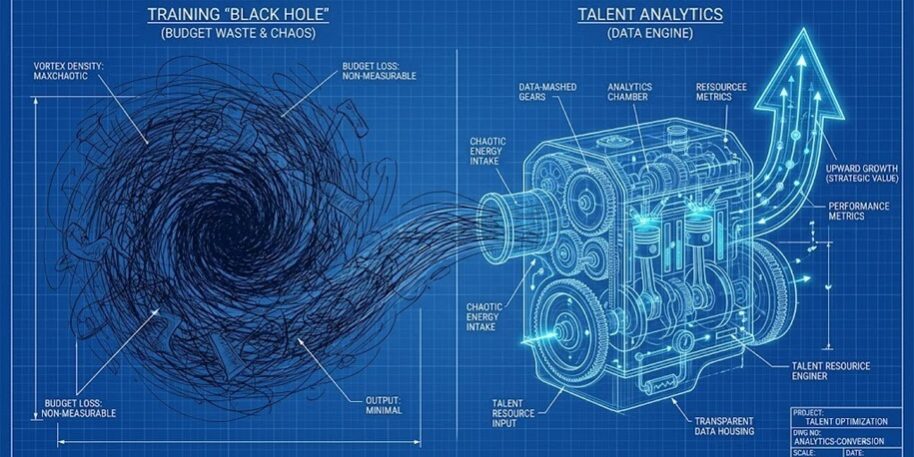
Stop throwing your training budget into a black hole. If you can’t see the progress, you can’t prove the value. Discover how talent analytics and historic data turn “invisible” language growth into undeniable ROI.
The “silent ceiling”: when you can’t measure what you can’t see
Imagine your company has invested €50,000 in language training for your customer support team over the last year. At the annual board meeting, the CEO asks a simple question: “Are they actually better at German than they were last January?”
You look at the attendance sheets. You see that everyone “completed” the course. But can you prove that their CEFR level moved from a shaky B1 to a confident B2? Without talent analytics, you’re stuck giving a vague answer like, “They seem more confident.” In the world of high-level business, “seeming” isn’t enough to protect your budget.
This can be a point where employees stop growing, but because there is no workforce data to track them, the stagnation goes unnoticed until a major communication error occurs with a client.

Leveraging talent analytics to overcome the “self-assessment” fear
One of the biggest hurdles in talent management is the human element. Let’s be honest: most employees are afraid to admit what they don’t know. If an employee feels their grammar is failing, they can’t follow a technical briefing, or they aren’t able to participate in small talk, they are unlikely to raise their hand and ask for help. They fear it makes them look “unqualified.”
This creates a “knowledge gap” that is invisible to HR. Talent analytics removes this fear by replacing subjective self-reporting with objective, regular auditing. Instead of asking, “Do you need training?”, you provide a baseline audit. When the data is objective, it’s no longer about admitting failure – it’s about identifying a growth opportunity. By using workforce data to pinpoint exact needs, you create a culture where learning is driven by facts, not feelings.
Proving training ROI through historic data and trend analysis
To a CEO, training is an expense until you prove it is an investment. The only way to show training ROI is through historic data.
By conducting regular audits – like every six months – you create a “language biography” for your workforce. You can literally show the trajectory of your team’s growth.
- The “before”: 40% of the team was at B1 level.
- The “after”: 85% of the team has reached B2/C1.
- The result: A 20% reduction in “time-to-resolution” for international client tickets.
This is the peak of talent acquisition strategy and retention. When you can map talent needs and trends, you can predict where your team will be in a year, allowing for much more accurate long-term workforce planning.
Identifying specific talent needs with granular reporting
Generic training is often a waste of resources. Why send an entire department to a “General Business English” course if half of them only struggle with writing emails or talking to Customers?
Effective talent management software should tell you exactly where the “leaks” are. Through the language audits, you can see if the downward trend is in vocabulary knowledge or writing. If your team is great at writing emails but freezes on video calls, you don’t need a general course – you need a targeted speaking workshop. This precision is what maximizes your training ROI; you only spend money where it is actually needed.

Strategic workforce data: predicting the future of your team
Beyond just “fixing” current problems, regular auditing allows you to see talent needs and trends before they become crises. For example, if your workforce data shows that your Junior Developers are all stuck at a B1 level, you know that in two years, you will have a leadership gap because none of them will be ready to manage international projects.
By identifying these trends early, you can implement language training now, ensuring that your future Senior Managers are ready to lead on day one. This is evidence-based hiring and development at its most sophisticated.
Data is the engine of growth
You cannot manage what you do not measure. By moving away from “one-off” tests and embracing a system of regular, objective auditing, you turn your workforce into a transparent, growing asset. Talent analytics don’t just tell you where your team is – they tell you how far they can go.
Don’t let your talent stagnate in the dark. Bring their progress into the light with Focus Audit Tool.
Ready to see the real impact of your training budget?
Stop guessing and start growing. Use historic data to prove your training ROI and lead your team to global success.
Contact us today or fill out our request for an offer to start tracking your team’s talent growth today.